Showing posts with label podcast backstory. Show all posts

April 15, 2021

More About Corn Fairies


Corn Fairies are an invention of Carl Sandburg, renowned Mid-Western poet.  They appear in "The Rootabaga Stories," which is a collection of short, fairy-tale like stories for children, inspired by the every day magic of the Mid-West.  Specifically, they are from the story "How to Tell Corn Fairies if You See 'Em."

"Have you ever stood in Illinois or Iowa and watched the late summer wind or the early fall wind  running across a big cornfield?  It looks as if a big, long blanket were being spread out for dancers to come and dance on."  Well, corn fairies come and dance on those corn fields.  They sing and dance and make the corn grow.  They shoo away mice and crickets and nail down the corn in high winds so it doesn't blow away.

Corn fairies wear overalls, ("The reason they are proud is that they work so hard.  And the reason they work so hard is because they have overalls.") which they weave themselves from corn each year.  When corn fairies laugh, the laugh comes out of their mouths like a golden frost.  And you can tell where a corn fairy is from, because the corn fairies in each state have a different number of stitches in their overalls.  Some regional variances also have various accessories made of different kinds of flowers.

I don't often use folk tales or creatures that only appear in one source.  But here, I believe corn fairies (although specific) tie into a long tradition of fairies who aid in growing flowers or forests or crops.  Also, it feels as if the original short story (which has little plot outside of Carl Sandburg's daughters asking him how to identify corn fairies and him explaining) is set up as a jumping off point for other stories.  He presents a character and expects children to come up with their own stories about that character.  There's something in the question and answer format of the story (where he is clearly making things up as he goes along) that feels as if it's teaching his daughters how to create a story, how to add details, how to roll with it.  He has created a folk tale and would be not be upset when it takes hold and grows and bends.

October 24, 2019

More about the Hodag

Season 5, episode 10: Come See the Hodag!

The Hodag is a fearsome critter from Rhinelander, Wisconsin, where it is a local attraction, the high school's mascot, and in the name of several local businesses.  It's fame has led to appearances in our old friend William Cox's "Fearsome Critters of the Lumberwoods," several Paul Bunyun stories, an episode of Scooby Doo, and a Harry Potter expanded universe entry on Pottermore.  (One of these did not do any research, and I'll give you one guess as to which one.)


To talk about the history of the Hodag, we first have to talk about Eugene Shepard.  He was a surveyor, timber cruiser, and renowned prankster/humorist.  He illustrated several Paul Bunyun stories, which were then widely circulated.  Later in life, he ran a resort in Rhinelander.  And he invented the Hodag.

Shepard started spreading rumors in 1893 about seeing the hodag out in the woods.  He described it as having "the head of a frog, the grinning face of a giant elephant, thick short legs set off by huge claws, the back of a dinosaur, and a long tail with spears at the end."  He claimed it was 7 feet long, 30 inches tall, and weighed about 200 pounds.  In other descriptions, the hodag is a cross between bulldog and a dinosaur and about the size of a large dog.  It's favorite food is white bulldogs, which it eats only on Sundays.

Shepard gathered up a big posse of men to go out into the woods and kill the hodag.  The sheer number of people that went out with him showed not only how powerful the hodag was, but also how brave the people of Rhinelander were.  Unfortunately, they had to kill the beast, and they had to do it with dynamite, so they returned back to Rhinelander with a charred hide, feeling successful.  In 1896, Shepard brought the Hodag up again.  This time he claimed to have caught one alive by gathering together a bunch of bear wrestlers, who put chloroform on the ends of sticks, and poked the sticks into the hodag's cave until it passed out.

black and white image from 1893 of a group of men surrounding a hodag
Capturing a hodag

By then, the hodag had nearly gone extinct, he explained, due to the severe lack of white bulldogs in the area.  So, of course, he put the captured Hodag on display at the Rhinelander fair grounds, where people would pay a dime to go into the hodag's dimly lit tent.  The dimly lit part was important, because if the Hodag knew that so many people were looking at it, it would become violent, and no one wanted that.  In the dark, the hodag would swing its tail and roar and people would scream and run away.  This all worked really well for Shepard until some people from the Smithsonian announced that they were coming to inspect his creature, at which point he fessed up that it was really a carved stump covered in cow hide and it's spikes were cow horns.  It moved with wires, and the growls were Shepard's sons standing behind it, making scary noises.

This does not stop the people of Rhinelander from enjoying the hodag.  Ans it shouldn't.

October 17, 2019

More about the Albatross

Season 5, episode 9: The Albatross

The albatross is an actual family of sea birds.  They have the largest wingspan of any living bird, reaching up to 12 feet in width, which allows them to fly for 10,000 miles over open ocean without landing.  The albatross is a symbol of the Cape Horner's Association (people who have sailed around Cape Horn).
blue flag with red circle reading AICH St Malo and an albatross face
Association of Cape Horner's Flag

They appear largely in the mythology of Pacific peoples, but this episode is in conversation with stories from western traditions, most specifically the Rime of the Ancient Mariner, by Samuel Taylor Coleridge.

In the Rime of the Ancient Mariner, there's a guy on his way to a wedding, which is about to start. The bride has arrived and the band is playing and he's anxious to get inside and watch this wedding.  But he's stopped by an old mariner who sets him down on a rock and tells him a story and the story is so captivating and the ancient mariner's eyes are so wild that the wedding guest can't leave.  In the story, the mariner set out on a ship headed south, when all of a sudden there was a storm that blew them to Antarctica, where they were surrounded and trapped by ice.  An albatross appeared, flew over the ice, and guided them back to the open sea through a fog while a south wind picked up.  The sailors where cheering and crying, when all of a sudden, the mariner shoots the albatross.  At first, he's wracked with guilt and all his friends are like, "How dare you kill the bird that lead us out of the ice and brought this wind that's bringing us home!"  But when the fog clears and the wind keeps up, they say, "Maybe the bird actually brought that fog, and it's a good thing you shot it."  But, as soon as they decide this, the wind dies and the ship is stuck for days and days in the middle of the ocean, where they see slimy monsters rise up out of the water and the water burns green and they think spirits are following them.  This is where the line "Water, water, every where, /Nor any drop to drink" comes from.  Everyone agrees it's the spirit of the albatross that did this to them, and they hang the albatross' corpse around the mariner's neck as punishment.  The mariner sees a ship approaching and assumes they're saved.  (There's a wild bit here where the mariner's lips are so parched that he can't speak to draw attention to the ship, so he bites his own arm, and drinks his own blood so he can shout out.)  But as the ship approaches, it's a ghost ship, and aboard it is Death and Night-mare Life-In-Death, and they play dice and Night-mare Life-In-Death wins, and everyone aboard the mariner's ship except the mariner fall down dead, their souls making the same noise as the mariner's crossbow when they leave.  The mariner is stuck alone on the ship for a week, unable to die.  Finally, he notices the slimy things in the water are alive, he blesses them and feels love in his heart, and the albatross falls off his neck.  It rains and then a wind picks up, and when the moon rises that night, all the undead sailors stand up and sail the boat.  They all lie down again when the sun comes up, and the wind disappears, but the ship keeps moving because a spirit under the ship is moving it. Eventually, he comes within sight of land, and a luminous seraph (an angel) appears over each corpse and waves at the lighthouse until a boat comes out.  When it gets close to the ship, the ship sinks straight into the ocean, and the mariner ends up in the little boat.  When he gets the the shore, he feels the need to tell his story to the man who rescued him, and now he wanders around, compelled to tell his story to people.

Honestly, the thing I like best about this story is the framing device.  A guy with wild eyes just runs up and won't let you leave until he's told you a ghost story.  This happens to me at least once a month.

A second, less familiar story with which this episode is interacting is the story of the last Great Auk in the British Isles.  Great Auks were real birds that have been hunted to extinction because their feathers made really good down for pillows, their meat was delicious, and sailors made oil from their fat.  They also had no fear of humans, and the preferred method of hunting them was to walk up to a bird and strangle it with your bare hands while a hundred other Great Auks watched. They were a bit like large penguins, except they lived in the North Atlantic.  The last Great Auk was found on an island off Scotland in 1840.  By then, it was already a rare bird and the three guys who spotted it were like, "Whoa!  Look at that weird penguin!"  Instead of killing it (like pretty much anyone else from the time period would have done), they decided to grab it, tie its legs together, and take it with them.  The bird started to wail, the rain started to fall, and they holed up together in a tiny hut to wait out the storm.  They kept it alive for three days, but the bird would not stop wailing and the storm would not stop storming, and they grew stir-crazy and convinced that the Great Auk was causing the storm because it was a witch.  To put a stop to the storm, they decided to stone the bird to death, which does not seem like the quickest or easiest way to kill a slow, flightless bird, but what do I know?

What we learn from these stories is that you just shouldn't bother large birds, because they're magic.

October 10, 2019

More About Worms

Season 5, Episode 8: Worm Day


The North English worm is a bit like a dragon, but without wings or (sometimes) legs.  It's mostly a big serpent and usually lived in lakes and rivers.  The area is full of dragon and worm stories from when their particular town was terrorized by a monster.  While there are similarities between the stories, there's no agreement on where the monsters come from, what they want, what defeats them, or what they look like.  The Sockburn Worm was defeated by a special sword, which is now presented to each new Bishop of Durham.  When the bishop takes up his position, the Lord of Sockburn tells the story of the worm.  The Worm of Linton also lived on the local hill, but was defeated by a knight shoving burning peat into its mouth.  The Laidly Worm of Spindleston Heugh is actually a princess turned into a Worm by her witch step-mother, and she's turned back into a woman when a knight kisses her instead of fighting her.

This episode is mostly in conversation with the Lambton Worm, a folktale that locals in County Durham still find important.  It was popularized by a song by C. M. Leumane in 1867.  The song is written in (kind of amazing) dialect.  Part of the chorus goes "An' aa'll tell ye aall an aaful story," or "And I'll tell you all an awful story."  It says that the villagers "Lost lots o' sheep an' lots o' sleep."  It says of the worm, "He'd greet big teeth, a greet big gob, An greet big goggly eyes."  It's rad.  In 1911, Bram Stoker wrote a novel called "The Liar of the White Worm" about the Lambton Worm.

In the folktale, a boy named John Lambton goes fishing in the River Wear.  In some versions, he goes on a Sunday and is warned by an old wise person that missing church is going to cause him trouble. While fishing, he catches a gross, wriggling eel-like thing.  It has nine holes on the side of its head, and ranges from the size of a thumb to three feet long.  It's not a fish, so he tosses it away into a well (later called the "Worm Well").  Many years pass and the boy goes off to the crusades and comes back to find the town and countryside ravaged by a gigantic worm that poisoned the well and eats people and cows and ruins crops.  It's so big that it has wrapped itself around Worm Hill seven times and really settled in.
a small hill covered in grass
Worm Hill

Lord Lambton, John's father, has pacified it by offering it the milk from nine good cows every day.  That's 20 gallons, or enough to fill the big, stone trough they set up for the worm.  A bunch of brave villagers and a few visiting knights set out to defeat it, but none of them are successful.  If a part of the worm is cut off, it just picks up the fallen piece and puts it back, reattaching it.  When the worm gets really irritated, it pulls up a tree in one of its coils and waves it around like a club.

It's pretty obvious that the thing John threw into the well grew up to be a huge monster, so he sets off to defeat it and make up for what he did.  The old wise person reappears and tells John that he needs to cover his armor in spikes and fight the worm in the river.  Then, after he's killed the worm, he has to kill the first living thing he sees or his family will be cursed for nine generations to not die in their beds.  You can see where this is going, but the neat thing about this story is that John does too!  He explains the whole thing to his father, and then makes a plan that when he kills the worm, he'll blow his hunting horn three times and his father will release John's favorite hound, which will run out to him, sacrificing a dog, but ensuring that John doesn't ironically kill his father.

John goes out to kill the worm.  When the worm tries to crush him, it spears himself on John's armor.  When pieces are cut off of it, they are washed away in the river before they can reattach.  After a long battle, John is victorious and (in another unexpected show of competence) blows his horn three times.

wood carving of knight fighting the lambton worm

However, John's father is so excited that the worm is dead and his son survived that, instead of releasing the hound, he runs out to hug his son.  Instead of "Well, now I have to kill you," John hugs his dad back, says, "Aww, Geeze," then has the dog released and kills it according to plan, even though he knows that it won't work.  His family is cursed.  Since the legend is local and the family is real, you can see how the next generations of Lambtons died, and they were all drownings or death in battle, so everyone in the area can point to that as evidence that the curse and the story are real.

I like how this story subverts my expectations.  I like how John's using his head.  I like how John realizes that having his descendants "not die in their beds" isn't that bad a curse, and he'd rather do that than kill his father.  But mostly, I like how the town had come to an uneasy truce with the worm where they fed it milk and it didn't bother them.  It seems like that could have lasted for a while.

October 3, 2019

More about the Furies

Season 5, Episode 7: The Fish Tank

The Furies, or Erinyes, were three Greek goddesses of vengeance.  They were particularly concerned with homicide, unfillial behavior, disobedience to parents, violations of the respect due to old age, offenses against the gods, violations of the law of hospitality, and perjury.  The Wikipedia page puts it well: against the insolence of the young to the aged, of children to parents, of hosts to guests, and of householders or city councils to suppliants.  When Cronus castrated his father Uranus and threw the genitals into the sea, the furies arose from the spilled blood, while Aphrodite arose from the sea foam.  From this violent beginning, the furies were most concerned with patricide, matricide, and crimes of a child against a parent.  They had a spot in the underworld, where they would torture these people after their death, and they guarded the "Dungeon of the Damned," where Tantalus and Sysyphus are kept.  But they also appeared on earth.  Mostly, they would inflict madness on their victims. They also caused illness and disease, and could send plague and famine onto a country harboring a criminal they were after.  The furies would stop only after their target went through a right of purification and did some sort of assigned heroic task.

They are described as ugly, winged women.  They have poisonous serpents around their waists and wrists and through their hair.  They held whips, and were either dressed as mourners in long, dark robes, or as huntresses.

Originally, the Erinyes were the personification of the curses shouted out at criminals.

Sometimes they are not individually named, and there are bunches of them.  In later stories, they were limited to three, given names, and made more beautiful instead of monstrous.  Their names are Tisiphone (Murder Restitution or vengeful destruction, punisher of murders), Alecto (Unceasing or endless, the punisher of moral crimes), and Megaera (Grudge or jealous rage, the punisher of infidelity, oath breaking, and theft).  Individualizing them is more of a Roman thing, with Virgil recognizing three of them and giving them names.

My favorite appearance of the furies is in the Oresteia, a trilogy of plays by Aeschylus.  In the first play, "Agamemnon," Agamemnon returns home from Troy.  You may know Agamemnon as the commander-in-chief of the Greek army at Troy.  He had been itching to go to war with Troy, so when Helen left Menelaus (Agamemnon's brother) for Paris of Troy, Agamemnon was the one who was like, "We need to go after her!  The Trojans won't get away with this!"  You may also remember him as the guy who stole Achilles' slave girl, thus irritating Achilles into the plot of the Illiad.  (I'm not a fan of Agamemnon.)  So.  Agamemnon returns home after the Trojan War, and it turns out that ten years ago, in order to get good winds for the voyage to Troy, Agamemnon sacrificed his daughter.  Agamemnon's wife, Clytemnestra, has been stewing on this the whole time, so when Agamemnon shows up, she murders him in the bathtub in retribution.  (She also wants the crown and also wants to take her long-term relationship with her boyfriend public and also is ticked that Aagamemnon comes home with a new girlfriend (/sex slave), Cassandra, who gives away Clytemnestra's vengeance plan even though no one believes her.)

No furies yet, but in the second play, "The Libation Bearers," Agamemnon's son, Orestes, learns about his mom killing his dad, and he's commanded by Apollo to take vengeance on his mom for this.  He has a moral dilemma with this, as 1. Agamemnon sucked and 2. if he kills his mom, the furies will come after him.  But you don't argue with Apollo, so he kills his mom and her boyfriend, and the furies are set after him.

In the third play, "The Eumenides," Orestes flees to Athens, and asks for help from Athena, who sets up a trial of Athenian citizens.  Apollo defends Orestes and the Furies prosecute him, and they have a big old debate about if blood vengeance is necessary, if you have to honor your father and mother the same, and if you have to honor the old gods (like the Furies) the same as the Olympian gods (like Apollo). Basically, this is all way over Orestes' pay grade, and the whole thing is just so Athena can set up the practice of trial-by-jury in Athens.  In the end, Orestes is acquitted, which ticks off the Furies, who threaten to torture everyone in Athens because of it.  Athena tells them that maybe they should change and become protectors of justice rather than goddesses of vengeance.  She urges them to break the cycle of blood for blood, tells them that Athens will honor them forever, and then threatens that she knows where Zeus keeps his lightning bolts.  She renames them "the Eumenides," or the kindly ones.

The whole thing is bananas.

September 19, 2019

More about the Honeypot Ants

Season 5, Episode 5: The Honeypot Ants

Honeypot Ants are real, and found in Australia, Africa, and North America.  The honeypot ants have division of labor, with some ants going out to gather food while others stay behind as honeypots.  These honeypots are overfed by the workers until their abdomens swell with honey they've created.  This way, they work as a living larder for the colony, and can produce honey from their crops and present them to waiting workers.  The honey they produce is similar to those created by bees and wasps, the ants just produce it in their bodies instead of in hives.


There are people across the world who eat the honeypot ants, usually by biting off the honey pot part.  I'm unaware of humans harvesting the honey from the honeypots while keeping the honeypots alive.

I'm also unaware of the honeypot ants' honey having special characteristics.  This aspect of the story is invented entirely from the fact that bee honey can take on different flavors depending on what the bees harvested to produce it, like lavender, sage, buckwheat etc, and the fact that lavender is supposed to have calming properties and sage is supposed to improve sleep.  So if we turn this up to eleven and make it magical, honeypot ant honey made with lavender will have calming properties, kind of like those essential oils they sell on the CTA.

This story comes out of the time my friend, Meg, gave our critique group a writing exercise.  She gave us each a random Wikipedia article and we had to sketch out a story inspired by it, with the idea of "Hey!  Be inspired by new things instead of stuck on the one project you've been working on for years."  She gave me honeypot ants, and I said, "What about an entrepreneur with ant friends!" and she was like, "I thought you'd go darker."  I think she was expecting that I would write something akin to the milk farm in Fury Road.

Nope! 

Ants!

September 12, 2019

More about the Minotaur

Season 5, Episode 4: The Labyrinth

There was once a queen of Crete, Europa, who was seduced (some stories say "seduced," in some that's not the word I would use) by Zeus, who came to her in the form of a magical bull.  She had three human-looking sons from this nonsense, and the king of Crete raised them as his own.  When the king died, it was unclear who would rule Crete, and in the power struggle, one of the sons, Minos, announced that it should be him because he had the favor of the gods.  He prayed to Poseidon to produce a majestic bull from the ocean so he could sacrifice it.  Poseidon provided, and everyone in Crete was so impressed that they made Minos king.  Minos then decided that it would be just fine if he didn't sacrifice the bull to Posideon and instead sacrificed a lesser bull.  Everything would be fine!  Poseiden, of course, did not approve, and in revenge cursed Minos' wife, Pasiphae, to fall madly in love with the majestic bull.  She just kept going on and on about the bull, staring at it out the window and sighing and whatnot.  There was nothing Minos could do except ask his royal inventor, Daedelus, to create a wooden cow costume that Pasiphae could climb inside and then live happily with her beloved.

Should I even bother pointing out how much of this is nonsense?

Anyway, unlike Europa, when Pasiphae gave birth, the baby was a scary monster with the head and tail of a bull.  They called it the Minotaur--the bull of Minos.  Minos ordered Daedelus to build a labyrinth for the monster to live in, and every year they sacrificed young men to it.  Eventually, the people of Crete got tired of sacrificing their sons to this monster, and a hero named Theseus came and killed the monster.  He navigated the labrynth by unrolling a string behind him given to him by Ariadne, Minos' daughter and the Minotaur's half-sister.

That's the story of the Minotaur, and although I like the imagery of the labrynth (and there's a part where Daedelus has to thread a string through a sea shell and does it by tying the string around an ant and letting the ant navigate for him), the rest of the story treats women so badly that I just want to slap everyone.

On a more historical note, Crete used to be the main power in the Aegean, and Athens used to pay tribute to Crete.  This tribute wasn't just goods and money, but also young men.  When the Creatians would come to collect, the priest would wear a bull mask.  Thus, the Minotaur was taking young men as sacrifice.  Also, in the early 1900s excavator Arthur Evans, while excavating the palace at Knossos, said, "You know, this palace is super complicated, almost like a labyrinth." It's a hypothesis that is since treated with skepticism, but still interesting.

It's also interesting to note that a labyrinth, unlike a maze, traditionally has no choices in the direction you can go (its called "unicursal").  There are twists and turns in a labyrinth, but the way you need to walk is never in question.  It leads you slowly towards the center, and is used for meditative purposes.  This doesn't fit so well with the part of the story involving Theseus, who needed a string to not get lost.  But it would make sense to me that the Minotaur would just hang out in the middle and all the young men would slowly come to him.


In Medieval times, labyrinths began to appear on the floors of cathedrals and in hedge mazes, and people would walk the labyrinths in meditation and contemplation, often with accompanying prayers or chants.  This practice is still used today, and it is comforting to place one foot in front of the other and be guided into the center.  I'll also note that when my son was stuck at home with strep throat, but felt good enough to be active for short bursts, I put a labyrinth design on the floor with painter's tape and had him run through it a few times.

Also note that IKEA is unicursal unless you take the shortcuts or wander off the path.

September 5, 2019

More about the Sphinx

Season 5, Episode 3: The South Shore Line Sphinx

The Great Sphinx of Giza was probably constructed around 2600BC.  It was buried up to the neck in sand, reclaimed by the desert, and mostly forgotten, so there aren't a lot of sources saying what the Egyptians thought of it or even what they called it during the Old Kingdom.  We know that the Egyptian version was male and, unlike the Greek version, was benevolent. It had great strength and cunning, and therefore guarded the entrances to temples.  We also know that some of the sphinx statues that remain have the faces of Pharaohs.

In the 15th-16th century BC, the image of the sphinx was brought to Greece and Asia, where it was appropriated to the point where the appropriated version is the one we're most familiar with.  The word "sphinx" is Greek, and it's unknown how the Egyptians referred to the creature during the Old Kingdom.  This was where the part about the sphinx eating you if you didn't answer a riddle came in.

During the New Kingdom era, the Egyptian Prince Thutmose fell asleep under the mostly-buried great sphinx's head while he was out on a hunting trip.  There, he had a dream where the god Horus told him that the sphinx needed to be restored, and that would make him a great Pharaoh.  He renamed it Harmakhet or “Horus on the Horizon." When he became Pharaoh Thutmose IV (1401 BC), he restored the statue and introduced the cult of the Sphinx to his people.  He also built the Dream Stele, which is a monument between the Great Sphinx's front paws, that explains this story.  But then, some historians think the whole thing about the dream was a cover up for how he murdered his older brother to usurp power, and he was trying to justify his right to rule with a dream.

The desert eventually took the Great Sphinx again, burying it up to its shoulders until a Genoese adventurer named Capt. Giovanni Battista Caviglia, tried to dig it out and ultimately gave up. After that, several more people tried, until eventually Egyptian archaeologist Selim Hassan managed it in 1930.

It's interesting to me that in Greek stories, they usually point out that the Sphinx came from somewhere else, usually Ethiopia.  So at least they're sort of honest about it?  In the Greek tradition, there was only one sphinx.  She had the face of a woman, body of a lion, wings like an eagle, and a tail with a snake head on the end.  The sphinx stood at the entrance to Thebes, and would only let people in if they answered her riddle.  "Which creature has one voice and yet becomes four-footed and two-footed and three-footed?"  Which I know better as "What has four legs in the morning, two in the day, and three in the evening?"  It's a person, because as a baby they crawl, then they walk upright, and in later years need a cane.


After quite a while of no one getting in or out of Thebes, Oedipus shows up and correctly answers the Sphinx's riddle.  In response, the sphinx either threw herself off a cliff or devoured herself.  Thebes was so grateful to Oedipus that they crowned him king, as the old king had recently been killed on the road by some hoodlum.  (It was Oedipus.)   Thebes also had Oedipus marry the queen, who some-odd yeas ago, left her baby out in the wilderness when it was prophesied that the baby would kill his father and marry his mother.  (Yikes.)  So you can see how the sphinx part of this story tends to take a back seat.

August 29, 2019

More about Al-Mi'raj

 Season 5, Episode 2: Dragon Island

The mi'raj is a rabbit from Persian poetry.  It has a single, black, spiraling horn coming out of its forehead.  It is territorial and can kill people and animals several times its size by stabbing them.  It can also eat foes several times its size.  Wildlife feared and avoided it, and people feared it because it would kill and eat them and their livestock.

From "Myth Match," a fantastic creature mix-an-match book by Good Wives and Warriors
The mi'raj is from Jezîrat al-Tennyn, or "Sea Serpent Island," which is in the Indian Ocean.  When Alexander the Great visited the island, he defeated a fire-breathing dragon that was terrorizing the locals and demanding two dozen oxen be presented to him a day. Alexander stuffed two ox skins with pitch and sulfur, making the beast sick.  Soon afterward, it died.  The people of the island showed their gratitude by gifting him a mi'raj.

It was said that the people of the island feared the mi'raj, and needed a witch to ward the animal away whenever it was sighted nearby.  Only a true witch could subdue the mi'raj so they could remove it from the area.

This story makes me think they sent one off with Alexander the Great just to get rid of it.

Al-Mi'raj is mentioned in the bestiary portion of "ʿAjā'ib al-makhlūqāt wa gharā'ib al-mawjūdā" or "Marvels of Creatures and Strange Things Existing" (shortened to "The Wonders of Creation"), a precursor to an encyclopedia by Zakariya al-Qazwini.  The book uses its bestiary section to say, "if these weird animals exist, why are you questioning that angels exist?" and therefore focuses largely on strange birds.  Al-Qazwini was a Persian physician, astronomer, geographer and what would today be called a science fiction writer.  He made up a lot of the creatures and stories, probably including the mi'raj, because it does not seem to appear prominently anywhere else until it was used as a monster in Dungeons and Dragons.


You'll often see it written as "al-mi'raj," but the prefix "al" is like an article so saying "the al-mi'raj" is like saying "the the mi'raj."

August 22, 2019

More about the Capricorn

Season 5, Episode 1: Capricorn

The Capricorn is often called a goat-fish or a sea-goat as it has the front half of a goat and the back half of a fish.

picture of a sea-goat
Image from askastrology.com

It's most commonly known as a constellation, especially since it's one of the constellations of the zodiac.  (December 22nd-January 19th)  According to Cosmopolitan (the experts), people born under the sign of Capricorn are "practical, self reliant, stoic and ambitious.  You'd want them in your corner... but maybe not at a party."

Imagery of sea-goats dates back to Babylonian times, but there isn't a whole lot of information about their myths.  Sea-goats are often associated with the Egyptian god Khnum, who is part man, part goat.

There's one story (with a bunch of variants) where after the Greek Olympian gods defeated the titans, one titan, Typhon, was unhappy about this and attacked, forcing the gods to flee to Egypt and go into hiding as various animals.  Dionysus turned into a goat and while hanging out in Egypt jumped/drunkenly fell into the Nile.  As the titan was about to land a killing blow against Zeus, a drowning Dionysus called out in surprise, and the titan was distracted, wondering what that alarmed goat noise was, enough for Zeus to finish him off.  Zeus was so pleased with Dionysus' quick thinking (sure, Zeus, we'll call it that) that he turned Dionysus into a constellation and let him ride through the heavens forever.  This story doesn't make a whole lot of sense, because Dionysus is still kicking around on earth long after this event, so sometimes instead of Dionysus, it's the god Pan, and since Pan and Dionysus are so similar they get interchanged a lot.

But my favorite story about sea-goats is about Pricus, the immortal father of the sea-goat race.  He and his children lived in the ocean, but enjoyed pulling themselves up onto the beach with their front hooves to sun themselves.  However, as the sea-goats spent time on land, they became more goat than sea-goat and they forgot how to reason and speak until they were eventually just regular old goats.  This made Pricus very sad, and he forbade all his children from going on land, which just made them churlish and determined to go on land anyway.  You can't tell me what to do, dad!  But!  Pricus was created by Chronus, the god of time, and so Pricus possessed magic time powers, where he was able to turn back time and no one would know except him. This brought his wayward goat children back into the ocean where he would have a second chance to keep them off land.  Then a third chance.  And a fourth.  Eventually he realized there was no stopping them, and he stopped turning back time.  He begged Chronus to let him die, but Chronus said no and instead turned him into a constellation so he could watch his mindless goat children do goat things for all eternity.

There's a lot going on there!

Now, in the spirit of full disclosure: my mom is a Capricorn.  Capricorns and moms are linked in my brain for all time, so this story caught my attention because the Capricorn is a parent.  So I, of course, called my mom, told her all about it, and then asked what she thought about it, as a Capricorn.  She said it certainly fit with her understanding of Capricorns, in that they're stubborn, and if their babies turn into goats, they'll just try again and again and again until their babies cut it out.  Then she asked me, as the daughter of a Capricorn what I thought of it.  I said that I didn't know, because she's always been very supportive of my decisions and has never told me to not turn into a goat.  "That's true," she said.  "I've never told you not to turn into a goat."  She then said that if I did want to turn into a goat, she would try to be supportive, and then listed several reasons why it would be a bad idea.

May 21, 2019

More on the Koi

Season 2, Episode 5: Chaos

Koi are actual animals that you may have seen in decorative ponds in fancy places.  In the US and most of the world, "koi" is the term used for a specific species of Japanese carp, which are patterned or speckled and come in a variety of colors--mostly orange, white, and black.  Early koi in Japan were kept in muddy ponds, which were common near rice patties.  The fish were used as a food source in addition to rice and veggies.  But the koi soon started to show mutations of different colors and, instead of eating those, they were kept as collectors items.  Koi breeding really took off in the early 1900s, spreading to the rest of the world.

In fact, my favorite phone game, Zen Koi, is one where you breed koi until you collect them all, eventually ascending them to dragon-hood.  You may also be familiar with Magikarp, the carp-like Pokemon that's pretty much useless until it evolves into Gyrados, the huge water dragon.


Koi are associated with joy, luck, beauty, both friendly and romantic love, strength, and courage.  There's a lot to get into with them.

But the koi episode of the podcast is specifically in conversation with a legend from the late Han Dynasty.  In it, a school of golden koi were swimming upstream in the Yellow River, trying to leap the waterfall at the end to reach the Dragon's Gate.  Most of the koi were not brave or strong enough to make it up the waterfall, but it's said that after a hundred years of trying, one finally succeeded and was transformed into a dragon. Thus, koi are symbols of perseverance, determination, and destiny fulfilled.

These are, of course, virtues that people want and identify with, so koi images appear all over the place.  Koi tattoos are super popular.  Koinobori, windsocks that look like koi, are usually flown over houses in Japan in late April and early May in celebration of Children's Day on May 5th, which is part of Golden Week.  Putting up a koinobori is a way to wish for the koi-like virtues of perseverance and determination onto your children.

May 7, 2019

More on the Tanuki

Season 2, Episode 3: The Weird Raccoon


The tanuki is a creature from Japan.  Unlike most magical creatures, the tanuki actually exists.  It's also called a raccoon dog, and it's a member of the Canidae family, closely related to foxes and wolves  While the real life tanuki is a pretty basic animal, and does basic animal things like find food and hibernate, in folklore they're yokai (a kind of Japanese monster) called Bake-danuki (monster raccoon dog) and are attributed with magical powers.  They are tricksters and have the ability to shape change.  Long ago, the folklore around the tanuki was influenced by Chinese fox-lore, and the tanukis were evil creatures that should be feared.  However, over the years, the image of the tanuki became more playful and goofy.  Now, unlike so many yokai, the tanuki use their shape-shifting powers not to tempt people and then murder them, but to make them look stupid.  They also bring generosity, cheer, and prosperity.


Some examples of the kinds of hi-jinx they get up to:

There was a tanuki that hung out on a bridge, and whenever someone would cross the bridge, it would shave their hair.  There was a tanuki that disguised itself as a child and asked for piggy-back rides, because it loved piggy-back rides.  There was a tnuki who carried an umbrella and offered to share with people who didn't have their own umbrella, but once underneath, they'd be whisked away to another world.  There was a tanuki that disguised itself as a wine bottle, and when people tried to drink from it, it would roll around so they couldn't catch it.  There was a tanuki that disguised itself as a piece of cloth on the side of the road, and when people tried to pick it up, it'd fly out of reach.  Once, a tanuki changed into the shape of a monk and lived at the temple for years, until one day it fell asleep outside and accidentally revealed its true form. The other monks figured that he'd been a pretty good monk and didn't kick him out.

But tanuki are also symbols of prosperity.  Their big bellies are reminiscent of happy Buddhist monks (who used to be considered charlatans, who would deceive you, so the imagery works pretty well in bridging the more wily aspects of the tanuki with its cheerful side.)  Tanuki statues are set outside restaurants and bars, or in the windows.  These statues show the tanuki with a straw hat, a bottle of sake in one hand and a promissory note in the other. They're often depicted to have huge scrotums. Tanuki do have rather noticble testicles, but the exaggeration in some art borders on the absurd. This is because tanuki fur is so strong that gold workers used to wrap the gold in tanuki fur before hammering it down into gold leaf.  In Japanese, a small ball of gold is called a "kin no tama," and testicles are "kintama." Since the two phrases sound so similar, a tanuki's testicles are a symbol of good financial fortune and stretching your money.


There's a 1994 Studio Ghibli movie called Pom Poko, where a bunch of tanuki use their rascal-y trickster powers to stop deforestation.  In Mario games, Mario can put on the tanuki suit and then fly.  There's much debate over if Mario is turned into a tanuki, or if he's wearing a tanuki's skin, but I think the answer to that one is obvious.

For the podcast, I borrow mostly from folklore of the US and Europe.  This is because I try to not to let podcast episodes take too long to write, and I believe that the folklore of other cultures requires and deserves research.  What do their stories mean in the cultural context that produced them?  What did these stories mean when they first appeared--what were people afraid of?  How do people familiar with these creature relate to them: Do they think they're goofy, are they sacred, are they scary, are they obscure or part of daily life?  Failing to grasp the answers to these questions does a disservice to the monster, the folklore, and the people.  And as much as I wish I could be more diverse with the monsters, I'd prefer to have them absent than to do a poor job portraying them.  It's a trade off that I struggle with.

There are only a few instances of monsters outside Eurocentric traditions where I've felt I had a good enough grasp to write about them.  The tanuki is one.  (The koi is another.)  And I hope I did this goofy critter justice.

April 23, 2019

More about the Hoop Snake

Season 2, Episode 11: The Race

The Hoop Snake is a fearsome critter from the US and Canada.  There are sightings dating back to colonial times, and it was popular enough to be in a Pecos Bill story.  The snake grabs its own tail and rolls like a wheel, straightening out at the last second to skewer its prey with the sharp spike of its tail.  It's hard to tell if its poison kills its prey on contact or if its prey dies because it's been skewered.  You can escape a hoop snake by hiding behind a tree, so the tree is skewered instead of you, or by jumping over a fence, which the snake will have to straighten out to crawl through, thus slowing it down.

There are other mythological snakes around the world that latch onto their own tail.  The most well known is the Ouroboros, which is a symbol for infinity, or all being one, and was very popular in the iconography of alchemy, which had a strong focus on living forever.  August Kekulé, a famous organic chemist, discovered the structure of Benzine in 1865 after having a dream about the Ouroboros--a story that's about as truthful as Newton discovering gravity when an apple fell on his head, but whatever.

It was a wacky dream!

There is also the poisonous Tsuchinoko of Japan, which can bite its own tail and roll like a wheel, but can also speak lies and jump a meter into the air where it then preforms a second jump while still airborne.  There's also the Jormungander of Norse Mythology, the serpent that grew so large that it surrounds the world and it able to bite its own tail.  Ragnorok begins when it lets go of its tail.  Since the hoop snake is such a recent legend, it's fair to say that stories of the hoop snake are informed by its predecessors. 

It's also fair to say that there are a bunch of snakes in the South-West, and they are terrifying.  Coming up with a goofy snake makes it a little less frightening, while at the same time warning people to give snakes some space because they might chase after you at fifty miles an hour.  Also, the Mud Snake (a real snake species) likes to coil up in a loop, and has a pointy little tail that it points at predators to get them to back off, even though it can't actually sting or poison anything with that tail.

For this story, I thought, if Hoop Snakes were real, surely someone would have one and use it for something weird.  Since they chase things at high speeds, a drag race seemed a good idea.

April 16, 2019

More about the Jackalope

Season 2, Episode 4: The Jackalopes

The jackalope is a fearsome critter of North America.  It's a jack rabbit with antlers.

Stories about horned rabbits have cropped up across the world, but the American variant traces its roots back to Douglas Herrick. Herrick was a hunter and taxidermist, and in 1932, he put together the first taxidermized jackalope by stitching antlers onto a rabbit. That first jackalope was displayed in the La Bonte Hotel in Douglas, Wyoming, where it became a big tourist attraction. Other taxidermized jackalopes followed to the point where many people thought (and still think) that they must be real.

While most stories about monsters come from a place of trying to explain the unknown and giving yourself a little scare when you think, “well, it might be true,” stories about jackalopes are more tongue-in-cheek with both the teller and the listener knowing it doesn’t exist. Stores in Wyoming sell jackalope milk, but the New York Times notes that that’s ridiculous, because milking a jackalope is too dangerous for a sustainable business. They only breed during lightning storms, and even though the rabbit part would lead you to believe that they multiply, the antler part of them makes the process difficult, thus their scarcity. You can lure out a jackalope with whiskey, its beverage of choice.

Jackalopes can imitate human speech and learned to sing from cowboys around camp fires. They use this skill to avoid capture by leading hunters off track, shouting, “Over here!” and “Not that way!” and “Help! Help!” in the voices of the hunter’s buddies.

April 9, 2019

More on the Dullahan

 Season 1, Episode 9: Lost Your Mind

The dullahan is a kind of Irish fairy.  They usually ride around on horseback with their head tucked under one arm.  The head is gruesome looking with a smile that stretches across the face and skin that looks like stale dough or moldy cheese.  Sometimes they drive a carriage, which is made out of bones and driven by six black horses that move so fast that the friction of the wheels sets fire to bushes on the sides of the road.

It's said that when the dullahan stops riding, someone will die, and when they ride up and say your name, they call your soul from your body and you drop dead.  The eyes in its head can see all around, so it holds its head aloft in order to see the whole countryside and find the home of a dying person.  If you happen to spot a dullahan riding across the country, instead of saying your name, it may just throw a bucket of blood on you or blind you in one eye.  They have an irrational fear of gold, so carrying some with you is a decent defense.

The dullahan is inspiration for the Headless Horseman in The Legend of Sleepy Hollow, but my favorite fictional dullahan is from the 1959 live action Disney movie, Darby O'Gill and the Little People, where the banshee calls the dullahan to take Darby's dying daughter away, but Darby offers himself in her stead, which leads to a scene of him sitting around in the dullahan's creepy bone carriage while on his trip to the afterlife.

I took some extreme liberties with this one.  There's no evidence at all that dullahans could put their heads back on their shoulders and have the heads look not creepy enough to interact with people.  But I thought the extremeness of their strangeness was a good jumping off point to tell a story about the friction between honoring your roots and assimilating into American society.

April 2, 2019

More on the Snow Wasset

 Season 3, Episode 10: Regina

The snow wasset is another fearsome critter from North America, listed in William T. Cox's "Fearsome Creatures of the Lumberwoods."  The snow wasset lives in the snowy areas around the Great Lakes and north to the Hudson bay.  It's a monster created to explain what happened to lumberjacks who vanished in the woods in the winter.  They were eaten by snow wassets.

The creature travels around under the snow, feeding on hibernating animals, but also if given the chance leaping out of the snow to attack prey.  They look like long weasels or otters, and are said to be "four times the size of a wolverine and forty times as active."  In the summer, they grow little, stubby legs so they can move around, but in the winter, they shed those legs and move by wriggling through the snow.  They also change color with the seasons for better camouflage: white fur in winter and green fur in summer so they can blend into the cranberry bogs where they hibernate.

I'm sure the snow covered Midwest must have been terrifying during pioneer times and the lumberjack heyday when people would vanish into the stow with some regularity.  But there's something about the Chicago snowdrifts that stay for weeks and weeks on the edge of every sidewalk and in the corners of every parking lot.  They draw the eye when I'm walking home alone.  Could something be lurking there, ready to pounce?  The primal fear of the unknown under the snow is still alive and kicking in my lizard brain. 

I wanted to write about a pack of snow wassets attacking a snow plow, but I eventually felt that there wasn't enough going on there to maintain the whole A-plot of an episode.  In the Regina episode, the snow wassets stay in the background as a threat that looms in the unknown.

March 26, 2019

More about the Squonk

 Season 2, Episode 9: The Squonk

The squonk is a fearsome critter from American folklore.  The earliest written account of the squonk is from William T. Cox's Fearsome Creatures of the Lumberwoods--a book from which I take a lot of monsters.  The squonk lives in the forests of northern Pennsylvania, and it's one of the many creatures that arise out of lumberjack tall tales.  Lumberjacks' jobs were grueling and dangerous, and they were isolated out in the forests.  Out in the wilderness with physically taxing jobs and no women-folk around, they did a lot of manly man activities like cutting down trees and wrestling and spitting.  And since they were such manly men, their story telling had a competitive edge where they would constantly one-up each other. 

Paul Bunyun was so big--How big was he?--He was so big that it took four storks to deliver him when he was born!

Paul Bunyun was so big that when he was three weeks old, he rolled around too much and knocked down five acres of timber!

They told stories to entertain on nights they were too exhausted to arm wrestle, but also to give some explanation to the mysterious tragedies that took place around them. Jeff wandered off into the woods and never came back? Eaten by a monster.

The squonk fits in this first category of tall tale.  It doesn't kill or maim or lure people into the woods.  It's just weird and maybe funny if you think about it in a certain light. 

The squonk was so ugly--How ugly was it?--It looked like a pot-bellied pig, but with ill-fitting skin that wrinkled and bunched like a rhino.  It was covered in warts and blemishes and clumpy patches of wiry hair.  It was so ugly that it hid so no one could see it its ugliness.  It was so ugly that it spent all its time crying.

The squonk can avoid capture by crying so hard that it turns into a puddle of tears.  In almost every description of the squonk, it's mentioned that one time some guy caught a squonk in a bag, but by the time he brought it home/back to camp/to is competitor naturalist to prove the squonk's existence, the squonk had turned to liquid.

Even though it arises out of such a manly man tradition, and the squonk's ugliness and its over-exuberant emotions about being so ugly is meant to be a joke, you can guess that I latched onto something else in this story.  People--especially women and especially young women--spend so much emotional labor on worrying about how ugly they are.  Feeling so ugly that you just want to hide and cry constantly?  I've been there.  Feeling like you'll cry so hard, so focused on one single flaw that you might as well just turn into a puddle of tears?  Yeah, I remember junior high. 

There's a lesson in there, which is basically "don't be a squonk."  Don't let your vanity get the best of you.  Don't be so consumed with your perceived ugliness that it's the only thing the "More about the Squonk" post talks about.  But then there's also a lesson in there about not focusing on other people's looks until they feel they have to hide away and lose themselves.

March 19, 2019

More on Slue-Foot Sue

Season 4, Episode 3: The Legend of Slue-Foot Sue

The stories of Pecos Bill are what's known as "fakelore."  A guy named Tex O'Reily claimed that he had collected stories about Pecos Bill, which were told by cowboys (much in the same way stories were told about Paul Bunyun by loggers) in the Southwest during westward expansion.  However, there weren't any cowboys telling stories about Pecos Bill, and it seems O'Reily made them up and presented them as if they were folklore.

I have to applaud this.

Pecos Bill was a cowboy known for his supernatural riding, roping, and shooting abilities.  Some examples of his adventures: He fell out of his family's covered wagon as an infant and was raised by coyotes until reunited with his human brother, who eventually convinced Bill that he wasn't really a coyote.  He roped and rode a tornado.  His horse was named Widow Maker because no other man could ride him, but then sometimes he rode a cougar instead.  His lasso was a snake named Shake.  And so on.  I like Pecos Bill stories.  They're all really silly.

I based this episode on the time Pecos Bill met Slue-Foot Sue.  And that goes like this:
Pecos Bill was camped by the Red River when Slue-Foot Sue rode by on a giant catfish.  Pecos Bill was so impressed that he proposed on the spot and shortly thereafter they got married.  As soon as they got married though, she asked her groom to do her a favor, and he said, "Anything!" and she said, "Let me ride your horse."  Now, as I said, Pecos Bill's horse was the wildest horse ever, and Pecos Bill was the only one who could ride him without being killed.  So it was with a heavy heart that he let Slue-Foot Sue ride the horse.  The horse immediately bucked her so high she bumped her head on the moon (or had to duck to avoid hitting the moon).  Now, since she was in her big, poofy wedding dress, when she hit the ground again she bounced, and just kept on bouncing for days and days, crying and screaming the whole time.  One version of the story says that Pecos Bill lassoed her down, rescuing her, but she was so shaken that she refused to ever see Pecos Bill again and demanded an annulment.  Another version said that after two weeks of not eating, Slue-Foot Sue was on the verge of starving to death, and Pecos Bill shot her to put her out of her misery.  Yet another says that she actually landed on the moon and lives there now, and coyotes howl at the moon in remembrance.  Whichever way, Pecos Bill never loved again.

I think that's a pretty raw deal narratively for someone skilled enough to ride a giant catfish to get bucked off the horse immediately and then cry about it.  Something about it doesn't make sense to me.  I feel like she should dust herself off and say, "That is truly the greatest horse."  Or if she were to cry, it would be from embarrassment rather than from the trauma of bouncing in a big, poofy dress.  Something is fishy here, and I started thinking how maybe someone adjusted the story and why they would do that.  Who would gain from Slue-Foot Sue's portrayal as a damsel in distress?

March 12, 2019

More on Unicorns

 Season 2, Episode 1: The Wooded Island

Unicorn stories are all over the place.  Unicorns have appeared in stories and on artifacts for millennia.  There are unicorn-like animals in the folklore of Europe, the Middle East, North Africa, and Asia.  With a history this long and stretched over such a large area, it's not surprising that there's no one common story of what a unicorn is or what it does.  The episode "The Wooded Island" focuses on more European interpretations of this creature, so I'll mostly be talking about that in this post.  However, I hope someday to write about the kirin or the shadhavar or the okapi. (One of these things is not like the others.)

For the most part, unicorns are horse-like (although some look like goats) with a long, spiraling horn coming out of their foreheads.  The horn has all sorts of magical properties like being able to cure illnesses and clean tainted water.  In Europe, shady merchants used to sell narwhal horns, saying they were unicorn horns, thus convincing people unicorns existed in the wild. 

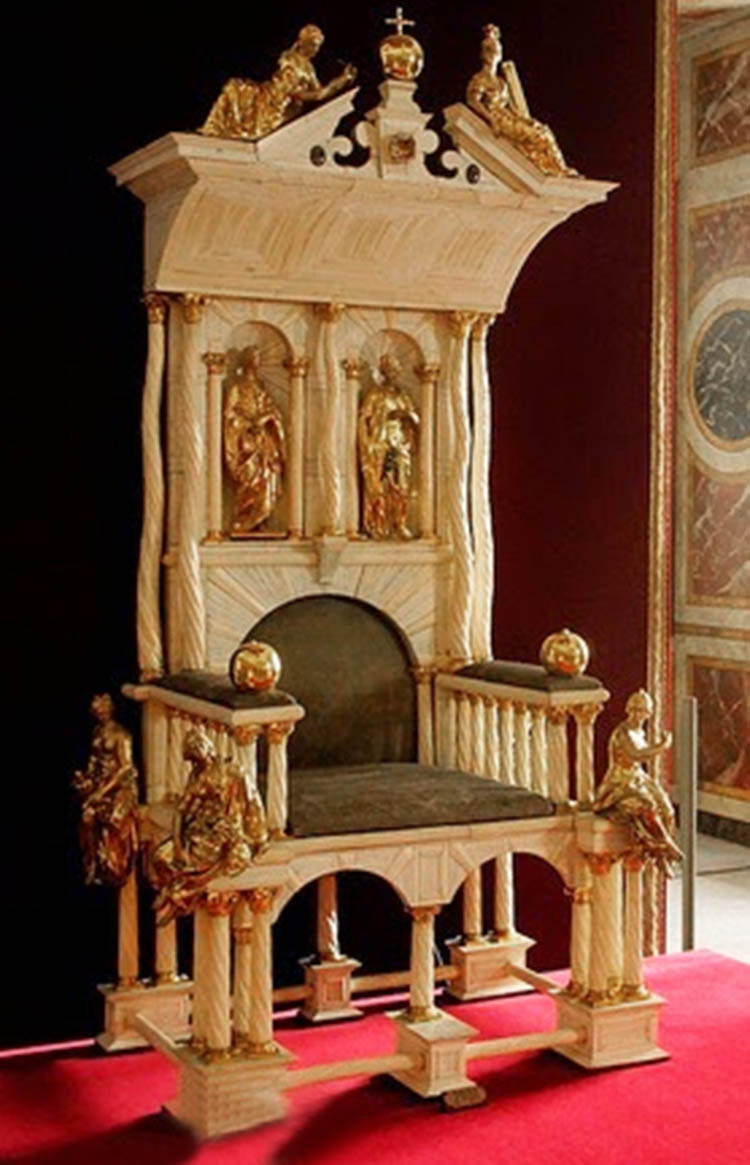
The Throne Chair of Denmark is said to be made out of unicorn horns
This emphasis on purification ties in with the only way to catch a unicorn: for a virgin to lure it up close so the unicorn will lay its head in her lap, at which point knights would rush out of their hiding places in the woods and kill it.

But towards non-virgins, unicorns were wild and vicious.  They'd use their deadly, powerful horns to impale people.  Not only that, but they refused to be captured to the point where if capture were imminent, they would throw themselves off a cliff and land so that they impaled themselves on their horn.  Since they'd rather die than be captured, they became an important symbol in Scottish heraldry.  
Both the emphasis on purity and the gruesome horn stabbings have taken a back seat in contemporary American folklore about the unicorn, which now focuses more on the unicorn's cuteness and ability to fart rainbows. 

Visiting my dad over Christmas, he'd bought a unicorn coloring book to keep my three-year-old son occupied.  My favorite page was of a donkey with braces and a unicorn horn.  My second favorite page was an iced doughnut with sprinkles and a unicorn horn.  I think I might prefer this Lisa Frank-esque version to the version that's a terrifying stab monsters who slut-shames.

My favorite unicorn story of all time is a chapter in the Once and Future King (Book 2, Chapter 7) where Queen Morgause arranges a unicorn hunt for the visiting King Pellinore, who is feeling down.  Morgause announces that she's going to be the virginal bait, despite the fact that the chapter follows the adventures of her four sons.  Pellinore knows better than to point out any flaws in this plan.  The boys, suspicious of the visitors, decide they're going to catch their own unicorn.

Also of note is the Shel Silverstein poem/song "The Unicorn," which explains how there are no unicorns today because they didn't show up to board Noah's arc.

March 5, 2019

More on the Twelve Dancing Princesses

The Twelve Dancing Princesses is a fairy tale.  Like many fairy tales, there are different versions, but I based this episode on the one collected by the Grimm Brothers.  That version is in the public domain, and you can read it for yourself here

Here's how it goes:

A king has twelve daughters, who lately have been sleeping well into the afternoon and turning up with their shoes worn to pieces.  Even when he locks them all in their communal bedroom, they still seem to be getting out to go dancing.  He really wants to know where they go, but apparently doesn't ask the daughters, or maybe he does and they refuse to tell him and the Grimm Brothers didn't find it necessary to put it into the story.  The king offers a reward that if anyone can figure out where the princesses go, they can marry one of the daughters.  But if the suitor doesn't figure it out within three days, he'll be beheaded.  So a bunch of guys try, and they all get beheaded one after another.  One day, there's an old soldier walking through the woods when he comes upon a woman who's obviously a witch.  She says, "Where are you going?" and he says, "I was going to go try to figure out where the princesses are going."  And she says, "Well, take this cloak of invisibility.  And also don't eat or drink anything the princesses offer you.  Good luck!"  When he gets to the castle, and announces he wants to figure out where the princesses go, the oldest princess offers him some wine.  He thanks her and pretends to drink it.  Then he pretends to pass out.  Pleased with themselves, as soon as they're locked in their room the princesses open up a secret passageway behind the oldest sister's bed. 

I guess the old soldier was staying in their room, and that's how he saw this and was able to follow them into the tunnel even though they were in a locked room.  I also guess this is why all the guys were beheaded: because they'd all spent three nights in the princesses' bedroom?  It's unclear.

So the soldier puts on his invisibility cloak and follows them.  First they go through a cave of silver tress, then a cave of gold trees, then a cave of diamond trees.  The whole way, the youngest princess thinks she hears someone following them, but the oldest princess tells her she's being paranoid, and they keep walking.  They get to a magical lake where a fleet of boats comes up, each boat piloted by a prince.  The princes take the princesses to a magical castle where they dance all night until their shoes get worn out.  The old soldier snaps off some branches from the magic trees and then steals a golden goblet from the party, and when he announces to the king where the princesses are going at night, he presents these as proof.  The king asks which princess he wants to marry, and he says the oldest, because he's pretty old himself.

I guess he didn't mind that she'd tried to drug him.  I guess it doesn't matter whether or not she has any thoughts on this situation.

I also guess the king was able to do something to stop these nighttime excursions to a magical dance castle, but that's not part of the story.  Or maybe the dad didn't care about the shoes, he just wanted to know what they were up to, and now that he knows the eleven remaining princesses can carry on.  Do the princesses go back to the magic castle minus one sister?  Are they barred from re-entry after being discovered?  If so, do they miss it?  Did their father deny them their only means of escape?  And why did they need an escape in the first place?