This week's book is Well, that Escalated Quickly: Memoirs and Mistakes of an Accidental Activist, Franchesca Ramsey's
memoir. This was recommended to me by the Chicago Public Library on their list of Bold Books by Black Women.
Franchesca
is a you-tuber, who makes hair tutorial videos and sketch comedy
pieces, and hit it big with a sketch called "Shit White Girls Say to
Black Girls." This launched her career both as a comedy writer and an
activist. Her memoir discusses the hurdles she had to go through of all
the times she made mistakes and all the times success fell on her after
years of hard work.
The part I appreciate the most from this book
is her frank discussions of times she got it wrong. She talks about
how she went on TV for interviews after Shit White Girls Say to Black
Girls went viral, and how, although she felt that the way she was so
often treated smelled fishy, she didn't know the vocabulary to talk
about racism with clarity. She talks about how she got push back from
the black community for that lack of clarity, how hurt that made her
feel, and how she set out to educate herself so she would not offend
again. I appreciate her acknowledgement that people aren't born knowing
everything about how racism works, and what's racist and why and how to
stop it, even when they know that some things make them feel crappy,
it's hard to stand up and say so and it's hard to articulate exactly
what's wrong.
This is something that gets glossed over a
great deal: people make mistakes and then they learn. Should we as a
society drag someone for that one problematic thing they said that
once? Maybe, because then maybe they'll learn. Maybe, because maybe
the refuse to understand what they did wrong or to improve themselves
and stop doing it. And Ramsey gets into that, how you need to call
people out on their mistakes, but sometimes it's better to "call in,"
which is a fantastic concept and a great phrase. "Calling out" is done
publicly. "Calling in" is taking someone aside and saying, "Hey, that's
a problematic thing to say because of reasons, and I know it's hard,
but here's some ways to do better." And Ramsey talks about how this is
emotionally draining, especially when whoever you're calling in gets
offended and defensive and won't listen to you, even though you've been
sympathetic and patient, and spent time trying to educate.
This
book works really well, because Ramsey gives advice while also showing
that she's made mistakes. She's let rampant, racist, wild criticism
online get under her skin. She's been overly enthusiastic about calling
people out online. She's said things that were problematic. But she
shows that she was able to grow and learn from those mistakes, and that
gives me hope that I can too.
***
Next week: The Hero and the Crown, vintage sword and sorcery by Robin McKinley.
July 12, 2018
July 8, 2018
Folklore is Dad Jokes
I went to a reading this week by Edward McClelland, the author of Folktales and Legends of the Middle West. This
sounded so far up my alley that my family didn't even give me any
trouble for skipping out on bed time.
McClelland read several stories from Resurrection Mary to the Lake Erie Monster. But in listening to the Paul Bunyun stories, I realized what was happening:
The stories were chalk full of dad jokes. At the end of each dad joke, McClelland would pause, give us Pun Husky Face, and then keep reading.
"...And they took that copper and used it to make the dome of the Ohio capital building!"
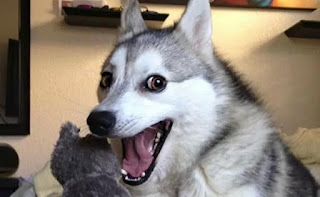
"...And that was the start of the Mississippi River!"
Dissecting it on the walk home, I thought about how it wasn't the presence of the dad jokes that was novel during the reading, but it was their placement. Usually you see them at the very end of a story, a joke ending where you would slap your hands together and throw them out into jazz hands. "Ehhh?! Get it!" The point of each of my grandad's stories was that at the end he had solved the last engineering puzzle keeping a building from being completed, and once it was solved they were able to construct such-and-such famous building in downtown Dallas that you'd have heard from if you were from Dallas. Or that he gave some advice and then that poet was Robert Frost.
It's like a flag that you wave at the end to say, "Got ya! That didn't really happen...Or did it?!"
So when these jokes are peppered throughout the story, as the punchline to each paragraph rather than the punchline to the full narrative, it sounds different to the ear. It's more, "Let me tell you a string of puns," rather than, "Let me tell you one long, winding joke that sucks you in for a while before spitting you out with how it didn't happen." So maybe not giving the listener time to get engrossed eases that sense of mild annoyance that comes after the big reveal. The annoyance where your friend does jazz hands and cackles at their brilliance, and you boo at them and tell them to delete their account.
But really, they're the same, and it took a different format for me to see it.
McClelland read several stories from Resurrection Mary to the Lake Erie Monster. But in listening to the Paul Bunyun stories, I realized what was happening:
The stories were chalk full of dad jokes. At the end of each dad joke, McClelland would pause, give us Pun Husky Face, and then keep reading.
"...And they took that copper and used it to make the dome of the Ohio capital building!"

Dissecting it on the walk home, I thought about how it wasn't the presence of the dad jokes that was novel during the reading, but it was their placement. Usually you see them at the very end of a story, a joke ending where you would slap your hands together and throw them out into jazz hands. "Ehhh?! Get it!" The point of each of my grandad's stories was that at the end he had solved the last engineering puzzle keeping a building from being completed, and once it was solved they were able to construct such-and-such famous building in downtown Dallas that you'd have heard from if you were from Dallas. Or that he gave some advice and then that poet was Robert Frost.
It's like a flag that you wave at the end to say, "Got ya! That didn't really happen...Or did it?!"
So when these jokes are peppered throughout the story, as the punchline to each paragraph rather than the punchline to the full narrative, it sounds different to the ear. It's more, "Let me tell you a string of puns," rather than, "Let me tell you one long, winding joke that sucks you in for a while before spitting you out with how it didn't happen." So maybe not giving the listener time to get engrossed eases that sense of mild annoyance that comes after the big reveal. The annoyance where your friend does jazz hands and cackles at their brilliance, and you boo at them and tell them to delete their account.
But really, they're the same, and it took a different format for me to see it.
July 5, 2018
I read A Flame in the Mist
This week’s novel is A Flame in the Mist
by Renee Ahdieh. This was a 2017 Goodreads Choice Award
Nominee for YA Fantasy.
Mariko, the only daughter of a
prominent samurai, is sent off to marry the emperor’s son. On her way to the imperial palace, her
caravan is attacked by the Black Clan, and she is the lone survivor. She disguises herself as a boy and sets out
to find the band that attacked her caravan, infiltrate them, then bring them to
justice when they least expect it. The
problem is that the Black Clan aren’t the cold blooded murderers she expected.
I’m always impressed with Ahdieh’s sense of place. The setting here is so rich and so deep. The setting permeates the characters, their
motivations and actions to the point when calling it a setting makes it feel
cheap. Maybe this is what setting is
supposed to be. It feels like you’re
breathing in the air of feudal Japan as you read. It’s impressive, and it’s impressive that she’s
done this twice with two very different settings, since she also wrote The Wrath and the Dawn.
I also like the romance in this one. They’re both on the same page, without
speaking of it, that this is not going to work out in the long run (unless some
earth shattering changes take place, which I’m kind of guessing they do in the
sequel), but they’re going to have a good time anyhow. I like how their relationship of publicly disagreeing
with each other and getting on each other’s nerves doesn’t change when they
start making out. No one gets all
doe-eyed, and I’m here for it.
***
Next week: Well,That Escalated Quickly: Memoirs and Mistakes of an Accidental Activist
by Franchesca Ramsey.
June 28, 2018
I read A Conjuring of Light
This week's novel is A Conjuring of Light by V.E. Schwab. This is the final book in the Shades of Magic trilogy, which includes A Darker Shade of Magic and A Gathering of Shadows.
When darkness from Black London makes its way into Kell's world, where it possesses the citizens of London and rots away the infrastructure, the team has to join forces to stop it.
I had some trouble starting this one, and I've been thinking about why.
As is the way with trilogies, the first book is a self-contained story that was easily extended, and the second book ended on a cliff hanger. So while the action of the second book picked up a few months after the events of the first book, the third book picks up only moments after the end of the second. That means that starting the third book, you're thrown straight into the super-high-stakes, dramatic action.
I wouldn't say that the first two started lighthearted, but the stakes started low and built up as the books went along. There was a lot of fun world building and showing off wondrous new places. Most of the second book revolved around a magic tournament, where, although each character was wrestling with internal demons and there were stakes for everyone, the stakes weren't world ending and it was mostly fun fight scenes and big parties. It was fun, with the over-arching plot of the series only really popping up at the very end.
In the third book, there was no light-hearted, good times, lookit this magic! It started off grim, when the parts I remember enjoying about the rest of the series was the fun.
It started grim and then kept going for the most part, but I love all these characters so much that I don't care. Every single one of them is great, and I was invested in every one of them. That might be another reason why I wish there was more fun swashbuckling and less EVERYTHING IS AWFUL AND WE'RE SCREWED: I want them to have fun.
It's a great series, and you should check it out. And the good news is that since the whole thing is out, you can read straight through and the third-book-drama won't be an issue.
***
Next week: A Flame in the Mist, Japanese inspired YA fantasy by Renee Ahdieh.
June 22, 2018
I read When Dimple Met Rishi
This week's novel is When Dimple Met Rishi by Sandhya Menon. This was a Goodread's Reader's Choice Awards nominee and on NPR's list of best books of 2017.
Dimple and Rishi are first generation Indian-Americans. While Rishi embraces Indian culture and his parents' vision for his future (including marrying a nice Indian girl that they pick out for him), Dimple is more Americanized and pushes back against her parents. She really doesn't like her mother's misogyny, especially when it comes to agreeing the let her go to Stanford, not because it has a great computer science program, but because it's full of nice Indian engineers for her to marry. Dimple is very excited when her parents agree to let her go to the exclusive, intensive app programing summer camp of her dreams, but it turns out it was all a big set up for her to meet Rishi. Rishi assumed her parents would have told her about the whole arranged marriage thing that their parents had set up, but he's wrong. There's a lot of awkwardness to deal with.
I liked how this book showed that there are different ways to be a first generation America. It's not a universal experience, even if their parents are from the same culture. But I also liked how at the same time it showed that Dimple and Rishi have similarities. The neatest part of the book for me was when Rishi offers her some khatta meetha, and she's like "Those are my favorite snacks!" and eats whole handfuls of them right after having a conversation about how much she hates her parents pushing Indian culture on her. It's pretty charming.
But along the same lines, there's a moment I did not like at all. There's another Indian-American kid at the camp, whose name is Hari and pronounces it Harry. And Dimple tells him that he's wrong and his name is Hari.
...Excuse me?
I think he knows how to pronounce his own name. However he chooses to pronounce it is his choice, and it is not okay to be rude to anyone about their name of choice. If he uses an Anglicized version, that is part of his personal journey and his personal relationship to the culture in which he lives and the culture his parents are from, and that journey is none of her business. She can say, "My parents would pronounce that Hari," or "In India, that's pronounced Hari." And it's irritating, because this not only is this coming from Dimple, who for the most part (as I said) would rather not with being Indian, so this defensiveness of "true Indianness" is weird. It's annoying because one of the big themes of the book is policing who's Indian enough. And it's also annoying because Hari is a pretty awful dude for a slew of legitimate reasons, but his "mispronouncing his own name to look cool" is presented like it's supposed to be further evidence against him being a good person. It's presented like the reader's supposed to say, "Geeze! What a tool!" But there's enough evidence already that shows that he sucks, and making me think instead that the main character sucks and giving me a moment to sympathize with him doesn't help the story.
***
Next week: A Conjuring of Light, the last book of the Shades of Magic series by V.E. Schwab.
June 14, 2018
I read "A Visit From the Goon Squad"
This week's novel is A Visit from the Goon Squad by Jennifer Egan. This was recommended to me by my friend Eric.
This is a series of interconnected stories that follow the people around Bennie Salazar, as his fame as a record producer rises and falls, and the people around Sasha, his kleptomaniac assistant. The focus shifts from chapter to chapter, passing through Bennie's band mates in high school, his mentor Lou and his family, Bennie's ex-wife and ex-wife's ex-boss, and through Sasha's family and friends. It skips around in time from the seventies to the near future where music has to be made to appeal to 6-month-olds who by songs by poking at their parent's phones. While each story focuses on a single moment, all together, you can get a sense of how the characters rise and fall over time, and how time changes everything.
While some of the individual chapters are amazing by themselves--I especially like the first chapter where Sasha explains to her therapist how she stole a woman's wallet while on a date, where the pull to steal things was presented in such a way as to make it both relatable and tragic--the part I got the most out of was how different each chapter was. You get an immediate sense of the main character of each story by how the style changes. There's a definite voice to each chapter and it comes through as the voice of the character rather than the voice of the author.
The one everyone talks about is the power point chapter, which I was pleasantly surprised not only by what a quality power point it was (I'm picky about good power point presentations) but also how easy it was to follow without the aid of the speaker who would be filling in the gaps and details when only the main points were presented on the slides. It worked really well to tell a layered story and I honestly haven't seen that done before.
But I feel like focusing on that chapter downplays how unique each of the other chapters were. There's one in the second person because the narrator is high and detached and sort of narrating what he's doing to himself. There's a whacky comedy of errors where a disgraced publicist tries to improve the image of a foreign dictator. There's an interview with a movie star that you know from previous chapters is going to end poorly. And aside from the form, there's the voice and the deep dives into each character's fears and ticks: kleptomania and extreme embarrassment remembering that thing you did twelve years ago, not wanting your husband to know how great you are at tennis at the country club but not wanting to lie about it, being your true "authentic" self, and not wanting anyone to know you sold out. The versatility is impressive.
***
Next week: When Dimple Met Rishi, YA romance by Sandhya Menon
June 7, 2018
The Last One Review
This week's novel is The Last One by Alexandra Oliva. I heard about this one because it was nominated as a Goodreads choice award nominee for 2017 in science fiction. I have problems with the science fiction label, but that's not anywhere near the point.
Twelve contestants go on a wilderness survival reality show, where part of the way through an epidemic hits the country. Or does it? Maybe it's part of the show. The production company is infamous for their last reality show where they used props and special effects to create a volcano, and this show has a $100 million budget. The only way off the show is to ask to leave by using a safe word, and he show is said to be about finding the contestants' breaking points, and the host makes it clear the contestants don't know everything that's happening. But then again...the dead body special effects are very good.
This book is upsetting. You may know how much I like books about reality shows, and I liked this book. But it was upsetting. I came to the end, and even though it had been clear for a couple chapters how it would end, I got to the last line and started crying. In retrospect, I think it's because the tension was finally released.
The structure of this book makes it work. There are alternating chapters between an omniscient point of view that mostly follows the episodes that air, and chapters from the first person perspective of "Zoo" (which is what the producers have nickname one of the contestants, who is a zoologist). With the first person chapters, we see what Zoo knows and follow how she makes sense of what she's seeing, starting a few days into a solo challenge while she walks mile after mile through abandoned towns. With the omniscient chapters we see how the producers are cutting the events together and warping the narrative, and we get to meet the other contestants. Knowing that the producers arranged tricks and props and actors to mess with the contestants adds weight to the theory that it's all part of the show. (It's also fun to see all the work the production assistants and the editor and camera operators do.). While the first person chapters show us how Zoo is rationalizing everything and why she keeps going. It personalizes the journey.
And there were several times when I had to stop and say, "Wait. Is this real?" I wasn't sure for a long time. I was hoping it was all part of the game for the sake of Zoo and for the sake of humanity, and also because that would have made my horrible, popcorn popping self cackle at the evilness this production company put Zoo through for my entertainment. Zoo thinks of episodes of misadventures as Challenges. The Rabid Coyote Challenge. The Marauders Challenge. And she thinks of her good luck as rewards for doing well on those challenges. The Abandoned Camping Gear Store Reward. She gives everything a cause and effect. She believes things are planned and people are watching her and if things get too bad a production assistant will appear with a med team. And she believes she has an out: if she says the code word, she'll be done and it'll all stop and she can go home. But at the same time, she doesn't say it, because she can take it. Or maybe she's not saying it because she thinks it's not part of the show and doesn't want that coping mechanism taken from her. She wants to stay in denial.
But my favorite part of the book was how deftly the omniscient point of view was used. It was great. It tells us that a contestant was thinking something harsh, but because they were trying to go for Fan Favorite, they said something more reasonable, to which a different contestant responded and third contestant said something snarky, which was later removed by the editor. It shows what the host is doing just before contestants make it to the finish line and how the contestants react on finding out they're last, and how the producers cheer that those contestants' coming in last will set up drama that the viewers will eat up, and then what the viewers think about the challenge and what they write online about it in the comments section. It moves organically and gives an image of what's happening that feels complete.
But this also gets into my least favorite part of the book, which is that these omnicisent sections are male gaze-y and weirdly racist. These sections refer to the contestants only by their nicknames, which include "Asian Chick" and "Black Doctor." (There are no other doctors.) These sections linger on the women bending over or drinking water, because the show lingers on these moments. They are almost in the producer's voice, but not from his point of view. So it's a statement about the people making this show, but, again, it's not explicitly from anyone's point of view. And I don't have to enjoy something that's problematic even if it's an accurate reflection of a point of view.
***
Next week: A Visit from the Goon Squad by Jennifer Egan.
Subscribe to:
Posts (Atom)