August 14, 2020

Chapter Endings and Jokes that don't Land

I recently read a blog post from BookFox, in which they categorized twelve different kinds of chapter endings.  They gave an example of such a chapter ending for each of their categories, which was illuminating.  It's worth reading, and I'm not going to repeat what they said.  Instead, I'm going to talk about what I got from it. 

Namely, however you end a chapter should have some pull to draw the reader further into the story.  A cliff hanger is the obvious one, but there was also ending in a question or a mystery or having someone enter the scene who you know will carry forward the action in the next chapter. 

On the other hand, the end can be a breath, or a moment of pause, and that's fine as long as the rest of the chapter sets up action pushing the reader forward.  Let's say something very exciting happened in the chapter, but then the chapter ends with a description or a character moment or reminds you of the main themes.  It's fine to take that pause because the reader is propelled through it and into the next chapter.  I found that to be a relief, because I find it exhausting to ready when every chapter ends on a cliffhanger, and even more exhausting to repeatedly write cliffhangers.  I'm reminded of feeling manipulated while reading The Divinci Code.  I'm reminded of getting bored reading weekly Shōnen manga, that attempt to have to have a cliffhanger or a reveal at the end of every issue.  The issues are so short that there are hundreds of reveals and therefore they all blur together until none of them are important.

But the main take away I got from this blog post was that I could go through the chapter endings in my novel and identify what I was trying to do in each one.  It gave me a vocabulary.  And with that vocabulary, I was able to pin-point what was going wrong with the endings that felt weak.

There are four chapter endings that I'm unsatisfied with.  In all four of them, I try to end on a joke that doesn't land.

Keep in mind, a lot of my jokes do land, and make for great chapter endings.  As pointed out in the chapter ending blog post, a good joke can elicit an emotional response that will connect your reader to the work so that they carry on reading.  Jokes can also be surprising, which can draw a reader along.  There are several good jokes in this novel (as far as I'm concerned).  And the ones that weren't working are good jokes that I hadn't set up to be "chapter ending jokes."  They aren't set up so they end in a cymbal sting.  They're set up like jokes thrown in during a longer dialogue.  I need to recenter the conversation leading up to them so that the conversation actually leads up to them.

If you have chapters, I encourage you to try this exercise, because it's a good one.

August 7, 2020

Characterization through a Lens

Spring Fling, a conference for the Chicago North Romance Writers of America, was the other weekend.  I didn't know about it, but a friend of mine attended virtually and had nothing but rave reviews about it.  Since it was virtual, participants got to see every presentation and panel, instead of having to chose to fit a schedule.  That sounds very very cool. 

"I'm so smart now," she told my critique group.  "I learned about tension and character arcs and--Oh!  There was this thing!" She dug into her copious notes, which shows better than anything what a great time she had.  "Okay," she explained, "so you can assign every character a movement."

There's a theory from anatomy and kinesiology called Laban Movement, created by a dance choreographer.  He said that any human movement has four parts: Direction, Weight, Speed, and Flow.  Each of these can is on a polarity: Direction is either direct or indirect, weight is either heavy or light, speed is either quick or sustained, and flow is either bound or free.  Or, as Wikipedia explains it: Both punching someone in anger or reaching for a glass are done by extending the arm.   But the strength of the movement, the control of the movement and the timing of the movement are different.  So basically, there end up being eight broad categories of movement:  Float, Punch, Glide, Slash, Dab, Wring, Flick, and Press.

Now you can assign each character a characteristic motion.  This character who is direct is a Punch Guy.  This anxious dude is a Wring Guy.  Then if you write your character through this lens, their physical stances and their motions will set them apart from one anther.  This will also trickle into their dialogue, because a Flick Person and a Float Person will speak differently.  Then it will affect their thoughts and motivations.  Looking at your characters through this lens will color every aspect of their characterization.

I think this is a helpful thing to think about.  Not because I believe there are eight type of people.  That rings of explaining everything you do through the lens of your astrological sign or your Myers-Briggs type, which I generally find reductive.  But I think this could be helpful because 1. it is descriptive enough to be an easy visualization to keep your characters from all sounding and acting the same.  And 2. if you keep referring back to this lens, it can keep your characters on target and in character.

A while back, a friend of mine was trying to explain a theory that I now see is remarkably similar: every character is a color and the three primary colors (red, yellow, and blue) are aspects of a character that I have now forgotten.  I think red was active and blue was thoughtful, so a red person acted before they thought and a blue person thought very hard but never acted and a purple person would both think and act.  My friend then proceeded to tell me that the main character of my story was red, and I got a bit miffed, decided this framework was unhelpful, and didn't think of it again until now.

But now, I'm working on revisions for a novel, and I'm reading through and constantly asking myself "What does this scene have to do with this central theme?  How can I bring the theme out in this section?  How can I tie it all back together?"  It's kind of like I'm looking at my whole novel through a lens and making sure everything lines up and stays on target.  And suddenly these methods of forming a character through a lens make more sense to me.

It doesn't matter what lens you look through: movement types; elements like water, air, fire, and earth; or even zodiac sign.  Simply having a lens, even if you only use it during one round of revision and not through the entire writing process, can be useful.  Just coming back to one central visualization, one solid idea throughout a story can pull things tighter and cut out extraneous bits that wander away from the point you're trying to make or the idea you're trying to express.

July 28, 2020

Am I a Failure?

This was previously posted on the Chicago Writer's Association Write City Blog.

***

“Mama. I have a question. Four plus six is ten.”

I stare at my four-year-old son for several beats before I say, “That’s right,” and then ask, “Was that a question?”

He trots off. I turn back to my Word document. What was I doing?

Right, I’m doing revisions on my novel. There’s an important theme at the end that isn’t fleshed out well enough at the beginning, so I’m reading through and looking for opportunities to make it more prominent. Several of those opportunities involve adjusting the world-building, so I need to hold it all in my head enough to make sure I don’t contradict myself later.

“Mama.”

“I’m working, sweetheart.”

“I have a question. When caterpillars’ skin gets too small, they build a cocoon.”

I have no idea if that’s how that works. “Okay. Can you go play by yourself?”

He trots off. I open my homeschooling document and add a note that we need to talk about what questions are.

Okay, what was I doing?

Just before the Illinois shelter-in-place order, I launched season six of my short story podcast, meaning I had to write, record and edit audio in order to put out an episode a week for the next few months. I was also outlining in preparation for writing a second draft of a novel for Camp National Novel Month in April. And then I heard back from my agent with what I hope will be the last round of revisions before we begin submitting another novel. Things were busy, yet hopeful. Fulfilling.

And then Covid-19 hit.

In addition to my writing, I’m CFO of a small not-for-profit, which had to close its doors in March. I’m scrambling to maintain payroll while we’re bringing in less income, and I’ve taken over responsibilities I don’t usually have in an effort to keep our more at-risk employees at home. Meanwhile, on top of his full-time job, my husband has a teaching position at the University of Chicago this quarter, which is suddenly all online with pre-recorded videos and extra office hours over Zoom. Both of our workloads have doubled.

All that, and we have no childcare.

“Mama, I need a Band-Aid.”

Suspiciously, I ask, “Why?”

“No reason. Don’t look at my foot.” He tries to hide his torn toenail behind some blocks. I wrap his toe in a pikachu Band-Aid, and he tells me all about pikachu.

No work is getting done.

I cling to my writing. Should I only do eight episodes of the podcast instead of twelve? No, people have told me that they’re looking forward to the distraction, and consistently putting out content helps my brand. Should I not do Camp NaNo? That would throw off my whole timeline for this novel. Should I write to my agent and tell her that the revisions that are so close I can taste them—the revisions about to launch my career—will have to wait? Because I’m busy? Absurd.

How could I possibly justify not doing these?

“Mama, do all animals have eyes?”

Hey, that one is a question! And I know the answer. “Coral don’t have eyes. Or jelly fish. Or some salamanders that live in caves where it’s too dark to see.”

He trots off.
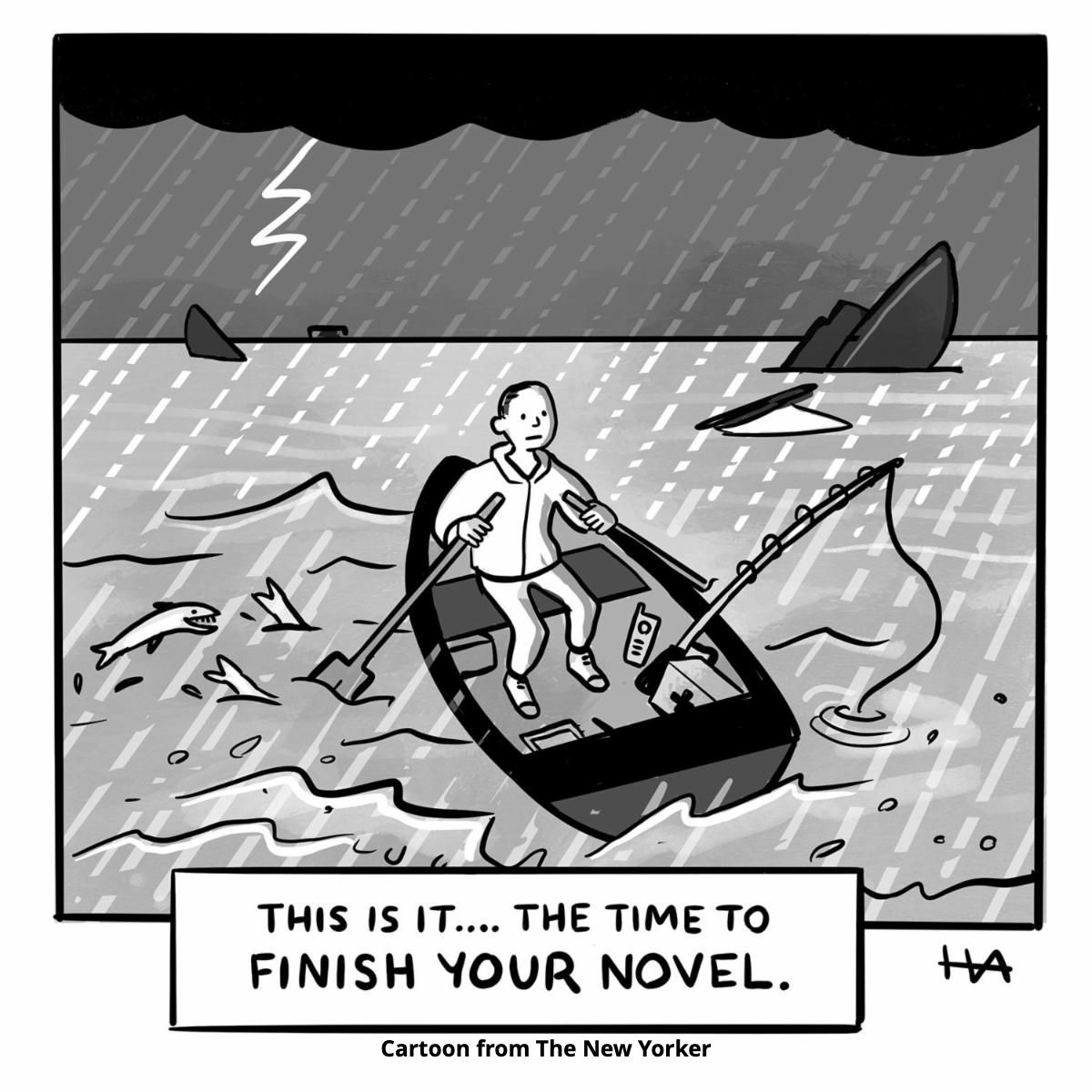
A New Yorker cartoon scrolls across my timeline. There’s man in a small boat, rowing on a troubled sea, a thunderstorm raging overhead. The caption reads, “This is it…The time to finish your novel.”
I stare at it far too long. I print it out and tape it to my computer. I write my agent an e-mail.

It’s so easy to see the ridiculousness in this cartoon. So much easier to see than the ridiculousness of the expectations I’ve put on myself.

“But!” the internet says, “Shakespeare wrote during a plague.” Tolstoy wrote with something like a dozen kids in his house. If I don’t finish these revisions in quarantine, it’s not because I lacked the time, it’s because I lacked the discipline.

Maybe if I stay up late. Maybe if I get up early. Maybe if I’m better at setting limits about not being disturbed while I’m working. Maybe if I do mindfulness exercises before I start writing so I can be entirely focused on it, then I can have a truly productive fifteen minutes before I’m interrupted. Maybe if I drink more coffee so I don’t collapse with exhaustion as soon as my son goes to sleep.
None of these work, because—obviously—I am a failure. I don’t want it badly enough.

And then someone posts an internal memo from the Canadian federal government on Twitter. I read it and cry. Crying is not uncommon these days. I print it off and tape it to my computer beside the cartoon.

It says, “You are not ‘working from home,’ you are ‘at your home, during a crisis, trying to work.’”

I am trying. During a crisis.

It goes on, “You will not try to compensate for lost productivity by working longer hours…Your team’s success will not be measured the same way it was when things were normal.”

“Please don’t worry,” says the reply e-mail from my agent. “You aren’t disappointing me.”

As painful as it is to let go, right now is not the time for my revisions. Right now is the time to fight for my employees’ safety and livelihoods. Right now is the time to check on my mother who had, and then recovered from, Covid-19. Right now is the time to check on my husband, who’s been working in the other room for six straight hours. And right now is the time to be present for my son, who has slept with the light on for the last two months.

“Mama, I want to see a sloth. Can we go to the zoo tomorrow?”

“No, sweetheart. The zoo is closed, and we need to stay inside. Maybe we can go next month. Okay?”

“Okay. Write it on the list.”

I add it to the whiteboard list of the things we’ll do after quarantine: visit the zoo to see a sloth, visit the aquarium to see animals with no eyes, go to the playground, do my revisions.

May 7, 2020

Mostly Ghosts: The Spirit of Boyfriends Past


Capricorn done in pearler beads


The Twenty Percent True Podcast

Season 6: Mostly Ghosts

Episode 8: The Spirit of Boyfriends Past


April 30, 2020

Mostly Ghosts: The Matchmakers


Capricorn done in pearler beads


The Twenty Percent True Podcast

Season 6: Mostly Ghosts

Episode 7: The Matchmakers


This week, I'm lifting up 57th Street Books.
Support their Go-fund-me with $5 or more, send me your receipt to twentypercenttrue@gmail.com, and I will:
*Give you a shout-out in the next episode
*Tell you which object in your home is haunted.  You need that.


April 23, 2020

Mostly Ghosts: The Traveler


Capricorn done in pearler beads


The Twenty Percent True Podcast

Season 6: Mostly Ghosts

Episode 6: The Traveler


This week, I'm lifting up 57th Street Books.
Support their Go-fund-me with $5 or more, send me your receipt to twentypercenttrue@gmail.com, and I will:
*Give you a shout-out in the next episode
*Tell you which object in your home is haunted.  You need that.


April 16, 2020

Mostly Ghosts: The Secret Society


Capricorn done in pearler beads


The Twenty Percent True Podcast

Season 6: Mostly Ghosts

Episode 5: The Secret Society


This week, I'm lifting up 57th Street Books.
Support their Go-fund-me with $5 or more, send me your receipt to twentypercenttrue@gmail.com, and I will:
*Give you a shout-out in the next episode
*Tell you which object in your home is haunted.  You need that.