Showing posts with label Day Job. Show all posts

October 8, 2016

Moon Rant

People get science things wrong.  It happens.  But sometimes they'll get a fact wrong, and something small explodes in my brain, and I have the need to explain gravity or radiation or government funding or lab safety.  But the big one that gets me every time:

The Moon.

I don't want to be judgmental, but...well, I am.  That's on me.  I'm sorry that I'm judging you folks that are wrong about the Moon, because I know that people should not have ignorance held against them, especially over topics that have no bearing on anyone's life.

But it's there.  Like right there.  All the time.  Has been your whole life. 

The worst perpetrators are picture books and lullabies, which I've read and sung a lot of lately and I'm sure my son is tired of hearing about the Moon.  So I'm going to tell you about the Moon, and when you go to write or illustrate a picture book, you can know how the Moon works.

1. The Moon is not only up at night.

There's this idea that I see constantly that Sun=day and Moon=night.  The Sun being up does make it day, but the Moon part of this is bogus.  The Moon is up all night only during the full moon, the rest of the month it rises later and later, rising at midnight and setting at noon for the waning quarter moon, rising in the morning and setting at night for the new moon, rising at noon and setting at midnight for the waxing quarter moon, then back to the full moon again.

Proof.  The Moon during the day.  Credit: David Jones
People tend to think the Moon is up only at night because A) the Moon is fuller when it's in the part of its cycle that has it up during the night, and therefore it's brighter and easier to see, and B) just like the stars, it's harder to see the Moon during the day because the Sun is so bright.

So when in your story you have a fingernail sliver of Moon rising at midnight, my first thought is WHAT?!  SOMETHING CATASTROPHIC HAS HAPPENED!  The same with characters not being able to see at night because it's the new moon and the new moon doesn't give off any light.  No, they don't have any light at the new moon because the Moon isn't up. Also, if you're going to have a sacrifice under the new moon, that's at noon.

2. The phases of the Moon are caused by its position relative to the Sun and Earth.

Not because the Earth is throwing its shadow across the Moon.  That's called a lunar eclipse and it looks very different.  Related to that, a total lunar eclipse can only happen at the full moon and a solar eclipse can only happen at the new moon.  If your story has a solar eclipse with a crescent moon, there is something HORRIBLY WRONG because in order for that to happen a second sun would have had to appeared.
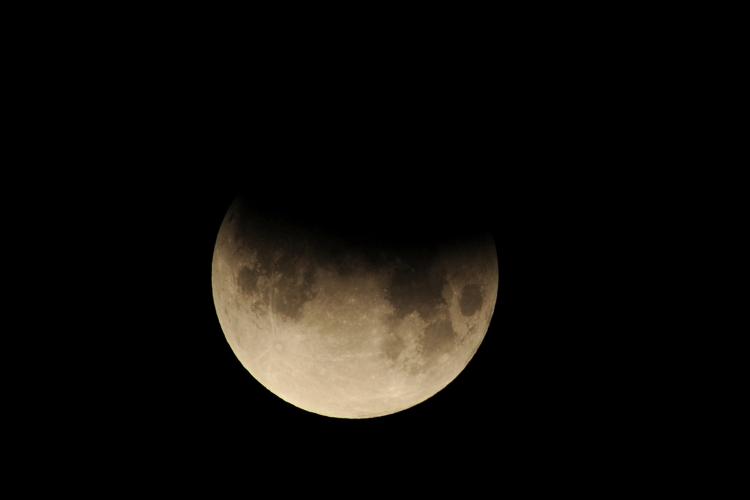
partial lunar eclipse.  See how the shadow is not as definite as a crescent moon.  ©bigstockphotophoto.com/hotshotsworldwide

The phases of the Moon depend on where the Sun, Earth, and Moon are in space. 

Half of the Moon's surface is always illuminated.  That's the side that is facing the Sun, while the side not facing the Sun will not be lit up.  This is not to be confused with the "dark side of the Moon", which is the side of the Moon that does not face the Earth (The same side of the Moon always faces the Earth.  It's cool), and we therefore can't see it from here, making it mysterious or "dark."  This gets confusing because sometimes the dark side of the Moon is literally dark because it faces away from the Sun, and sometimes the dark side of the Moon is lit or partially lit because it faces or partially faces the Sun.


Note that no matter where the Moon is in its orbit, the side of the Moon facing the Sun is always lit and the side away from the Sun is dim.  This is also true for the Earth, where the dark part is night and the light part is day.

The different Moons drawn here represent four different moments in the Moon's orbit around the Earth.  (The Earth does not have four Moons, and the Moon makes a full orbit of the Earth about once a month.)


This shows how the Moon's position in space makes it look different for a person on the Earth.  See their thought bubbles as they look up at the Moon?  The Moon hasn't changed all that much, but a person's perspective of the Moon will change.

Now, looking at these diagrams, it seems like the Moon ought to go through all its phases every day, so why is it a quarter moon when it rises and still a quarter moon when it sets that night?  That's because these diagrams are a bit misleading: the Moon orbits the Earth about once a month, while the Earth is in the middle there spinning, spinning, spinning away.

One day in the life of the Moon would look more like this:


Note that the Moon rises around noon and sets around midnight.  Also note that that red stick person is going to see a quarter moon from every position where it's possible to see the Moon.

August 12, 2014

Your Preteen Should Read Hemingway

I wrote an article this week about getting your preteen to read when your preteen hates reading.  It's really a shame that it was such a short article, because I could have gone on and on. 

When I'm writing an article, I like to poke around first and see what other people are writing in their articles that hit the same topics.  I want to make sure I'm not repeating what's already out there (as much as that's possible), and I want to see the state of the conversation which I'm entering.  But this week's article took me by surprise because so many of them revolved around the topic of "What to do when your boy child hates reading."

From just reading the titles, my interest was piqued.  I usually hear about how girl children decide they hate science and math.  This is especially prominent once they hit middle school and suddenly there are all sorts of social pressures that tell them they shouldn't be good at math anymore because this is a masculine thing and they need to be focusing on feminine things.  (Like...pants?  I was very concerned with finding the perfect pair of pants in junior high because I thought they'd make my ass look awesome and get me a boyfriend, and I had this idea that that was a thing I wanted.  But now I'm thinking about it, "pants" aren't really that feminine of a thing.)  It's pretty clear that this decision to hate numbers and graphs is a product of indoctrination from societal forces and not because the girls are particularly bad at math (with their girl brains and their...nail polish? Nail polish makes you bad at math, right?  The fumes?)  So I thought to myself, Oh! Is there a similar effect on boy children who decide in junior high that it's not cool to read because our culture has decided that that's a feminine characteristic?  How fascinating!

But no.

That is not what these articles were about.

They, in fact, just fed the monster, not mentioning (until I dug deeper on a second go around) that there are societal pressures, and thereby ignoring that they exist and what the real problem here is.  Almost all of them encouraged parents to find books about trucks and sports and "not girly" things, because MAN FOLK READ MAN BOOK!  (Boy brains are made of snails and snails can't read.  It's science.) 

So, okay, I get that if your boy child is feeling the need to be all macho, and you want to appeal to his interests, he's going to gravitate towards stereotypically masculine topics.  (Like whiskey.  Or the first world war.)  But why phrase it as "not girly" topics? (That's a quote, by the way.)  Why not phrase it as "topics in which your kid is interested, whatever that happens to be?" 

(For example: your kid is interested in pie, even though all baked goods are inherently girly.  But wait.  Are they?  I'm confusing myself.  On the one hand, I assume all pie is baked by 1950s housewives with aprons and lipstick and heels, which would make pie a feminine thing.  But then, that's insane because, like I said, everyone likes pie.  Placing food on a gender scale is stupid.  So is labeling things like sports or space travel or pants.)

By this logic, would Harry Potter or the Chronicles of Narnia or A Series of Unfortunate Events be masculine enough to get recommended to an apathetic middle grade reader?  (Is Jesus more or less masculine than pants?) This is baffling to me.

One article suggested getting your son a mainly space in which to read, like a tree house (or a leather arm chair).  This is so the boy child's masculinity remains firmly intact even as they do the less-than-manly activity of reading

So this advice is basically saying, if your boy child is suffering from the fallout of gender stereotypes, you should help them by pushing them even further into those gender norms!

July 10, 2014

Fourier Series in Everyday Life.

I'm going to talk about math, and then I'm going to get philosophical, so stick with me.

There is this thing called a Fourier Series.  The Fourier Series is the subject of my favorite joke of all time, and no one ever gets it and that is one of life's cruelties. 

Basically, let's say you have a weird function and you want to find the equation for it. 


Like this step function I made in MS Paint.

Sometimes, it's just too hard to get the exact equation because the function you want was drawn in a default image editor, so you decide to get as close as you can and just use that. 
Oh yeah!  Looking good!
So I draw a sine wave (the blue line), which gets the up and down part but leaves something to be desired.  This first guess is called the first order term, or the first thing you do.  But we can do more.  We can take another sine wave, add it to this one, and together they add and subtract from each other to bring us closer to what we want.
A graph I didn't draw in MS Paint
So here, the black shows the first order term.  The blue shows the first order term added to another sine wave, and the red shows an even higher order term to get pretty close to that blocky function we wanted.  Ta dah!  Close enough!

Yesterday, I realized that I approach projects as if they were Fourier Series.  The first draft or the first try is like the first order term.  It's general and not even really close to what you want, but it's a start.  Then you go over it and make it a touch better, then a touch better than that.  The corners of your blocky function stat to come in.  You iron out individual pieces.  Only later can you start working out details until you get close enough to what you want.

June 9, 2014

Draw a Scientist

Education, science, and methodology day!

There's this activity that's pretty common, which made me really happy when I first saw it.  It's called the Draw-a-Scientist Test.  Basically, a class of kids is asked to describe a scientist and draw a picture.  They all draw white guys with wild white hair, wearing a lab coat, holding some kind of bubbling chemical in a beaker.  The class then goes on a field trip to Fermilab, and when they come back, they adjust their description and picture.  All of a sudden, scientists are normal people in jeans, in front of computers.  There are women and people of color thrown into the mix.  Check these out.


So neat!  Warms my little science heart!

But wait.

A group of researchers looked as these results and probably noticed that eighth graders drew the same picture of a scientist in a lab coat when asked to draw a scientist, even if they took the field trip to Fermilab as seventh graders and supposedly learned that scientists are just like you and me.  That, or they noticed that the pictures of scientists drawn after the field trip basically reiterate the theme of the trip, which was repeated over and over: scientists are normal people!

So they asked the kids instead to "Do a drawing which tells what you know about scientists and their work."  All of a sudden, the drawings looked a whole lot like the drawings that were produced after the field trip.  Turns out that when kids hear "Draw a scientist" they assume you're asking "Draw the most stereotypical scientist you can.  The one your teacher is looking for you to draw right now."

So this speaks to the fact that kids (and people in general) will often assume there is a correct answer and are good at judging the answer you want them to give.  You want them to draw an antisocial chemist with questionable hygiene?  Here you go!  You want them to draw the guy they met on the field trip with a speech bubble stating the point of the trip?  You got it!